Details of OpenJaw’s IATA ARMI certification is available on https://retailing.iata.org/armi/registry/openjaw/ .
This document provides information for non-OpenJaw developers who are sending NDC messages to the t-Retail Platform. Before using this document, refer to the Recommended Reading.
Recommended Reading
We recommend you familiarise yourself with the following:
Introduction
NDC (New Distribution Capability) is a travel industry-supported program (NDC Program) launched by IATA (www.iata.org) for the development and market adoption of a new XML-based data transmission standard (NDC Standard).
The NDC Standard will enhance the capability of communications between airlines and travel agents. The NDC Standard will be open to any third party, intermediary, IT provider, or non-IATA member to implement and use.
The NDC Standard will enable the travel industry to transform the way we sell air products to corporations, leisure, and business travellers by addressing the industry's current distribution limitations:
Product differentiation and time-to-market
Access to full and rich air content
Transparent shopping experience
The NDC (XML-based) Standard includes a set of schemas that covers the 'end- to-end' airline distribution process.
Distribution process
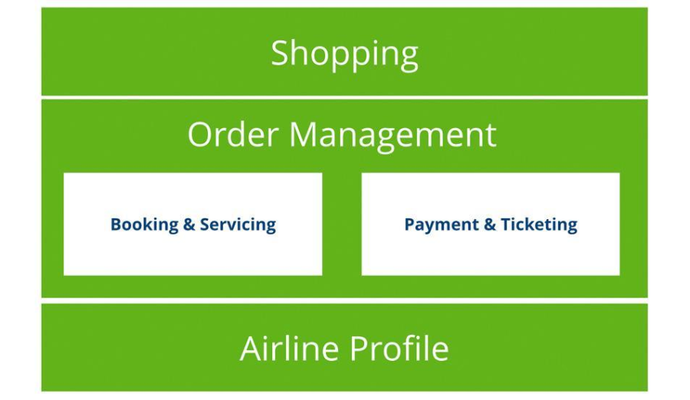
Shopping: Enable airlines to distribute their full product offers and to merchandise their baggage, seat choices, and ancillary services using rich content in an anonymous or personalized manner.
Order Management: Enable airlines to manage NDC-driven orders throughout their entire lifecycle from booking to fulfilment.
Airline Profile: Enable airlines to communicate the markets for which they are willing to respond to requests for offers and associated services.
OpenJaw NDC API Documentation
The OpenJaw NDC API Documentation is OpenJaw's implementation guide for IATA NDC Schema. The Message Flow outlines the sequence of messages required to perform a particular action using the API from Offer and Order creation through to Order Management. The consumer of the NDC 18.2 API documentation utilises the schema, request and response mappings, and message samples to understand how to interact with the API.
Request Mapping: Provides a description and example per element/attribute which outlines how a request message with different inputs may be used to trigger an event when interacting with the OMS. i.e submitting different search criteria.
Response Mapping: Provides a description and example per element/attribute which outlines how information will be represented in the response should it be provided i.e an Offer Price response with Fare Rules, Upsell, Ancillaries.
XML Samples: Provides a set of XML samples detailing out the full XML message which can be used to perform a particular action and its corresponding response.
The consumer (for example, internal testers, third party developers) of the API can reference the NDC schema, message mappings, and sample messages in order to understand how to chain particular requests with specific inputs. For example, you would reference the request mapping and samples in order to construct an NDC 21.3 AirShoppingRQ that corresponds to shopping search with the following criteria, and follow it on with an OfferPriceRQ and OrderCreateRQ in order to make a booking:
Search Type: Return
Origin:London (LHR)
Destination: Tokyo (TYO)
Passenger Mix: 2 ADT, 1CHD
Market: GB
Cabin Type: Economy
Seller ID: SkyScanner
This NDC content refers to Shopping and the Order Management process only for the Booking and Servicing.
OpenJaw's NDC Implementation
The OpenJaw NDC API details the current implementation. Our API documentation defines the interface for interacting with OpenJaw's implementation of the NDC 21.3 schema. Submitting an NDC request with a field not in our documentation will result in no processing of that field downstream in the OMS. In the request and response mappings, we include a multiplicity field to identify whether an element/attribute is optional or mandatory.
The IATA NDC schema may have an element/attribute set as optional, but the OpenJaw NDC API may have the same element/attribute set as mandatory. This is because we require this field/information in order to process the request specifically in our implementation.
The multiplicity field in OpenJaw NDC API utilises the following values:
Optional:
0..1: Optional zero or one re-occurring elements required.
0..n: Optional zero or many re-occurring elements required.
For example, the request element /IATA_AirShoppingRQ/Request/Paxs/Pax/AgeMeasure is not a required element for a Passenger. It is optional.

Mandatory:
1..1: Mandatory single element required.
1..n: Mandatory single or many elements required.
For example, the request element /IATA_AirShoppingRQ/Request/Paxs/Pax/PaxID is mandatory as all passengers must have a unique identifier. In our sample, we suggest a format such as PAX-ADT-1.

Terminology
This glossary will assist you in locating various elements in the NDC Schema which may not utilise the commonly used industry terms.
Industry/OpenJaw Term | NDC Schema |
|---|---|
Fare Family/Fare Families | PriceClassList |
Upsell Offers | OtherOffers |
Seller ID/SellerID | RetailPartnerID |
PTC Reference | PaxRefID |
Fare Basis | FarePriceType |
NDC 21.3 Overview
The OpenJaw NDC API supports the following services.
AirShoppingRQ/RS
OfferPriceRQ/RS
OrderCreateRQ/OrderViewRS
OrderChangeRQ/OrderViewRS
OrderRetrieveRQ
OrderRulesRQ
OrderReshopRQ/RS
OrderQuoteRQ/RS
OrderListRQ/RS
OrderHistoryRQ/RS
ServiceListRQ/RS
SeatAvailabilityRQ/RS
Additionally, OpenJaw t-Retail supports sending event notifications with the IATA_OrderChangeNotifRQ and IATA_OrderSalesInformationNotifRQ messages.